

Contact details
Foundation for Industrial History of Győr
Address: 9021 Győr,
Szent István út 10/a
Phone:
+3696520274
Fax: +3696520291
E-mail:
ipartortenet@ipartortenet.hu
More...
Szent István út 10/a
Phone:
+3696520274
Fax: +3696520291
E-mail:
ipartortenet@ipartortenet.hu
Map
Károly Neubauer and Son Match Factory
| Address of the memorial site, route planning | ||
| What can we see at the memorial site? | ||
| Brief overview | ||
| Detailed company history | ||
| Interesting facts | ||
| Literature, references | ||
| Related gallery |
| MEMORIAL SITE ADDRESS, ROUTE PLANNING |
| WHAT CAN WE SEE AT THE MEMORIAL SITE? |
Street view:
Pictures from our days:
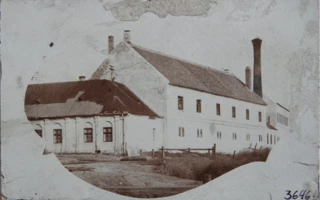
A picture from the past:
| BRIEF OVERVIEW |
|
The introduction of matchmaking in the city of Győr is linked to the Neubauer and Goldschmid families, and matches were produced in the factory in 1867. The company used the name Neubauer Károly és Fia from January 10, 1889. The first safe Swedish lighter was made in Hungary in the Győr factory. The factory successfully exhibited its products at industrial exhibitions, which increased the company's reputation and recognition, and by 1897 the number of employees had reached 140-150. Production was modernized through continuous developments, but despite this, the factory found it increasingly difficult to compete with the leading, large-capacity, modern Hungarian match factories. On January 13, 1905, the ownership of the factory was transferred to the Budapest-registered company Vesuvius Hungarian Match Factory Co., Ltd. Vesuvius Co., Ltd. had serious plans for the development of the Győr factory, but none of them came to fruition. In 1915, the factory was still producing, but in 1918, Szikra Hungarian Match Factory Co., Ltd., a group of Hungarian factories that also included Vesuvius Co., Ltd., sold the plant to Magyar Zománc és Fémáru Co., Ltd. A significant part of the match factories in the countryside were liquidated, and the remaining large factories were grouped into an alliance. The ELZETT Sheet Metal Factory later operated on the site. |
| DETAILED COMPANY HISTORY |
The introduction of matchmaking in the city of Győr is linked to the Neubauer and Goldschmid families. Károly Neubauer and Ignác Goldschmid applied to the city council in 1860 for an operating permit for a jewelry manufacturing business to be established in Újváros. An expert committee conducted an on-site inspection of the rented premises at Festő Street 38-39, who concluded that the building was surrounded by thatched-roof houses on a narrow street, and therefore fire safety considerations did not apply. At that time, white phosphorus was used for matchmaking, the toxic evaporation of which could have damaged the health of those living nearby, so the application was rejected.
In 1867, Károly Neubauer again applied to the city government to establish a match factory. This time, he wanted to establish the factory outside the city, in a rented house at No. 76, Nádorváros, where - as the application states - he would employ "poor" workers. Production began in the factory shortly after the permit was granted, which provoked protests from the population and the commander of the nearby infantry barracks. Despite the protesters' claims of fire danger and air pollution, the city's decision-makers did not revoke the permit.
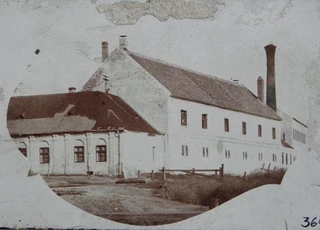
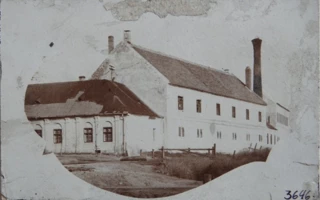
During the operation of the factory, it slowly but continuously developed, the factory site was transformed and expanded through land use planning, and in the meantime its address was changed to Kálvária utca 55. The main entrance was in the 18-window, ground-floor building, where carts loaded with raw materials and finished goods used to travel. The site was bordered by a two-story factory section from Kert utca, from which chimneys emitting gases and smoke generated during production stood out. The owners and their family members also lived in a residential building built on the factory site.

Photo fragment depicting a detail of the Győr match factory - laminated onto 150x95 mm cardboard
Xántus János Museum – Győr
source: http://www.magyargyufa.hu/gyufaipari-tortenelem/gyufagyaar/50-gyor.html
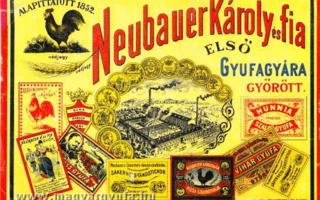
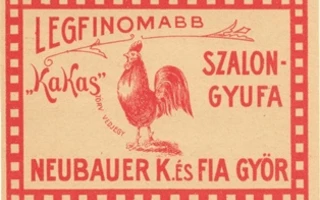
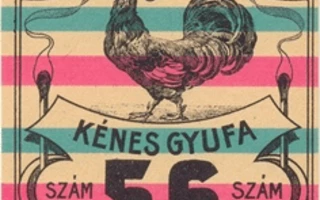
The match factory's emblem and trademark was a rooster standing between two ears of wheat, which appeared not only on invoices but also on numerous match labels.

http://www.magyargyufa.hu/gyufaipari-tortenelem/gyufagyaar/50-gyor.html
Initially operating as a private company, the factory employed 30 people in unmodern conditions in 1870, yet it produced a wide variety of matches. The factory, which was constantly expanding in terms of staff and developing in terms of technology, followed market demands and paid attention to the competition.
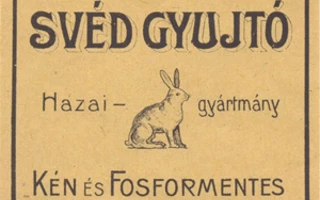
The first safe Swedish lighter was made in Hungary in the Győr factory. Instead of dangerous white phosphorus, the first match was made with red phosphorus by the Swede JE Landström, who is the creator of the safety lighter, the "Swedish match".


source: http://www.magyargyufa.hu/gyufaipari-tortenelem/gyufagyaar/50-gyor.html
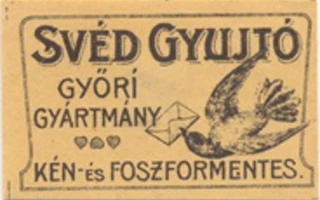
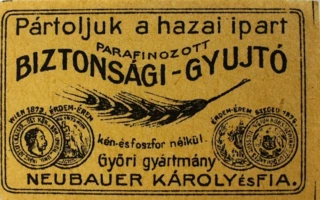
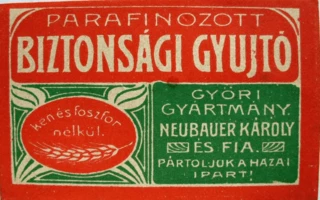
Among the factory's products were well-known paraffined matches without sulfur and phosphorus,


source: https://picasaweb.google.com/gyufasdoboz/Gyor?feat=flashslideshow#5512446155130294610
https://picasaweb.google.com/gyufasdoboz/Gyor?feat=flashslideshow#5512446094496162146
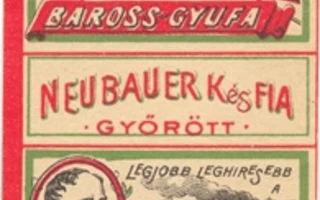
national, white mikado, brown swedish, cock salon, Baross, luxury and rescue matches,


Baross match - 1893. (From the collection of Frank J. Mrazik)
source: http://www.magyargyufa.hu/gyufaipari-tortenelem/gyufagyaar/50-gyor.html


"numerous" sulfur matches - 1905. (From the collection of Frank J. Mrazik)
source: http://www.magyargyufa.hu/gyufaipari-tortenelem/gyufagyaar/50-gyor.html
Matchstick labels offered a good opportunity to advertise the company and showcase charity.
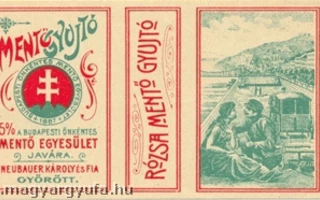
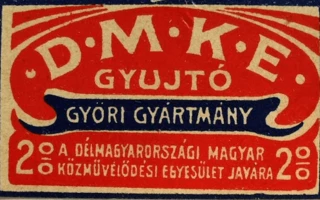
From the net profit of the rescue matches – as can be read on the labels – 5 percent went to the Budapest Voluntary Rescue Association, or 2 percent went to the Southern Magyarországi Public Cultural Association.

Rescue lighter - 1900. (From the collection of Frank J. Mrazik)
source: http://www.magyargyufa.hu/gyufaipari-tortenelem/gyufagyaar/50-gyor.html

source: https://picasaweb.google.com/gyufasdoboz/Gyor?feat=flashslideshow#5512446298651360994
Industrial exhibitions and presentations increased the company's awareness and recognition. Károly Neubauer took advantage of these opportunities:
In 1870, the company's match products were also on display at the Vienna public exhibition, alongside Károly Stádel's agricultural machinery, Sándor Céh's printed matter, and Mihály Nagy's pasta products.
In 1873 he was awarded a medal of merit in Vienna, and in August of the same year the 17th General Assembly of the “Hungarian Doctors and Naturalists” was held in Győr, and within the framework of this, an industrial exhibition was organized in the County Hall on August 23. He won a silver medal for the matchstick figure exhibited in the III. Department, among handicraft objects.
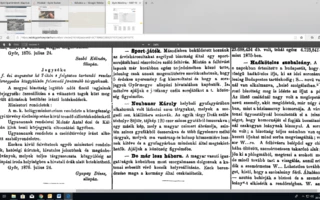
He received a medal of merit in Szeged in 1876. The 62nd issue of the Győri Közlöny of 1876 reports on the objects the factory owner entered for the exhibition

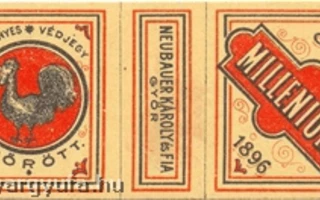
In 1896, he received a millennium medal at the Budapest exhibition organized to celebrate the thousandth anniversary of Hungary's existence.

Millennium Match - 1896. (From the collection of Frank J. Mrazik)
http://www.magyargyufa.hu/gyufaipari-tortenelem/gyufagyar/50-gyor.html
The factory employed more and more workers every year. Around 1881, the number of employees varied between 55-70 people, in 1897 the number of workers reached 140-150 people. The factory's daily production was 200,000 boxes and 15 million matches in 1897. The owners were able to achieve this result through continuous development: in 1884 they switched to steam-powered mode, in 1890 they purchased automatic machines, at which time 110 machines performed the work from the felling of the logs to the packaging.
The match factory was considered a dangerous enterprise, and small and large fires often broke out on its premises, usually due to human negligence. The Győri Közlöny, July 28, 1867, issue reported that “A fire broke out in the match factory in Nádorváros last Thursday evening, but it was immediately extinguished.” Not only the production of matches, but the matches themselves also proved dangerous: “On the 28th of this month, a young woman’s clothes caught fire on a street in the city center, probably by stepping on a match, but immediate help averted all danger.” It can be read in the same issue of the daily newspaper. In 1895, the wood processing machine shop and then the match packaging plant also fell victim to the fire.
The factory has been called Neubauer Károly and Son since January 10, 1889. The son, Izidor, had the same management rights as his father.

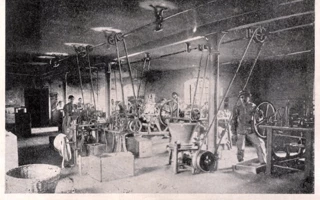
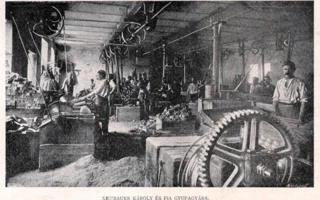
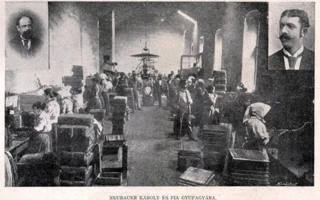
In the 13th issue of Vasárnapi Lapok in 1897, the advertising article about the match factory showed the production of a modern factory, and the newspaper also described the matchmaking process of the time. "The boxes are made from thin wood chips, which are peeled off from a tree trunk as strips of wood with the help of a peeling machine, this strip of wood is peeled off in one piece and as such a strip of wood is cut into equal pieces with the help of a dividing machine. These wood chips, which are made in various sizes, are folded with the help of machines and drawn in with a vignette. They are dried and stored. For sulfur matches, the paper sleeves are made with the help of machines and are also dried and stored. A factory that runs smoothly must produce 5-6 million finished boxes without interruption. The matchsticks are cut from knotless wood into equal parts with circular saws and then cut into matchsticks with the help of machines. These matchsticks are also cleaned and sorted with the help of machines. In the further process, the matchsticks are placed in frames with the help of a sorting machine, pressed, They are paraffined (fatty substance) and dipped in another machine (they get a head). In these frames, the matches already have a head and are placed in drying chambers for drying. In 2-3 hours, the matches are completely dry, when the finished matches are neatly removed from the frames with the help of a shaking machine. Now they are placed in boxes and packaged with vignettes that are provided in different ways depending on the type.”


photos: Vasárnapi Lapok – Illustrated literary weekly, Vol. I, No. 13, Budapest, June 27, 1897.
http://www.magyargyufa.hu/cikkek/neubauer-karoly-es-fia.html
In 1898, the factory began another major investment, receiving permission from the city government to build a 35 square meter heating surface, eight atmospheres operating pressure Cornwall boiler and boiler house. This construction was led by the widow of the deceased Károly Neubauer, Róza Goldschmid, and her son, Izidor. In the meantime, the widow's son Gyula was also given similar rights and obligations as his brother and mother.
Thanks to the waterworks construction works started in 1902, the amount of water required for production was provided from the Rába River. The match factory's monthly water consumption in June 1904 was 240 cubic meters . In 1901, the company employed 230 workers and produced about 20 million matches.
Despite all the modernization, the factory found it increasingly difficult to compete with the leading, large-capacity, modern Hungarian match factories. On January 13, 1905, the ownership of the factory was transferred to the Budapest-registered company Vesuvius Hungarian Match Factory Rt. for a purchase price of 96,000 crowns. The names of Neubauer Izidor and Neubauer Gyula were included in the purchase contract, and Neubauer Izidor became the director of the Vesuvius Rt. factory in Győr.
Vesuvius Rt. had serious plans for the development of the Győr factory, as in 1907 they received permission - in addition to the demolition of the outdated units - to build, among other things, a drying chamber, a sulfurization room, a dipping workshop, a filling and packaging room, and in 1908 a new factory chimney. However, nothing of the plans came to fruition, and in fact, after 1908 they only sought to preserve the condition of the Rt.'s Győr factory. In 1915, the Győr factory was still producing under the management of Ágoston Wágner, but in 1918, Szikra Magyar Gyújtógyárak Rt., a group of Hungarian factories that also included Vesuvius Rt., sold it to Magyar Zománc és Fémáru Rt. During this time, the 3rd Uhlan Regiment used the former factory buildings as a warehouse. It should be noted that the Győr factory, as the Szikra Magyar Gyújtógyárak Gyártelepe – Győr, was still listed as an operating factory in the Rt.'s statements in 1926, which is why some historical works mistakenly list the plant as an existing factory, even though it was already owned by Magyar Fémdobozművek in 1924, although the court officially dissolved the company only in 1929.

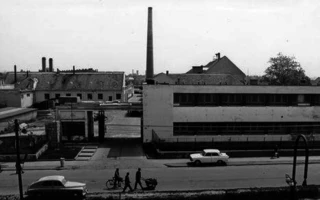
The Elzett Sheet Metal Works operated on the site of the match factory in 1969.
source: http://kony.network.hu/kepek/regi_gyori_kepek/elzett_lemezarugyar_gyor_1969
The changed political and economic conditions also played a role in the fact that a significant part of the rural match factories were liquidated, and the remaining large factories were grouped into alliances. During the war years, the continuous provision of raw materials was a problem, production costs increased, and the domestic market's absorption capacity decreased. These circumstances certainly contributed to the final cessation of match production in Győr, but its memory lives on in the lovely tongue-twister:
Come to Gyuri Győr, to the Győr match factory, to light a match!
The compilation was made using the study of György Veszprémi.
INTERESTING FACTS
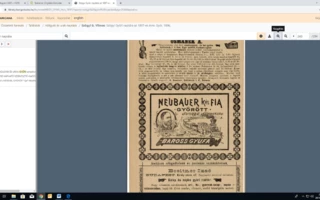
Advertisement in the Győr calendar for 1897

Szőgyi G. Vilmos: Ladies and Gentlemen, Győr's Millennial Calendar for the Year 1897. Győr, 1896. p. 258.

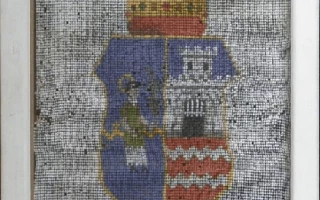
Silver medal, matchstick picture made of matchsticks depicting the coat of arms of the city of Győr, from 1874, property of the Győr Museum
Matchstick image size: 310x390 mm (approx. 17,000 matchsticks)
Name variations
Match Factory 1867-
Károly Neubauer and Son Match Factory/a January 10, 1889.-
Vesuvius Hungarian Match Factory Ltd. Győr factory January 1905-
Szikra Hungarian Ignition Factories Factory - Győr 1918-1926 (no longer in operation, listed on paper)
| LITERATURE |
- 1867. News column. In: Győri Közlöny, July 28, 60, no. 239, p. http://edok.gyorikonyvtar.hu/jadox/portal/displayImage.psml?offset=2&origOffset=1&docID=18159&secID=28530&qdcId=null&limit=10&resultType=0&schemaId=0&filter=null&action=browse&site
- 1876. Károly Neubauer… In: Győri Közlöny, July 30, No. 62, p. 2. http://edok.gyorikonyvtar.hu/jadox/portal/displayImage.psml?offset=1&docID=16166&secID=26801&qdcId=0&limit=10&schemaId=null&filter=gyufagy%C3%A1r&action=browse&site=search&type=simple
- 1897. Neubauer Károly and Sons. In: Vasárnapi Lapok – Literary illustrated weekly, I. vol., no. 13., Budapest, June 27. p. 219. http://www.magyargyufa.hu/cikkek/neubauer-karoly-es-fia.html
- 1987. György Veszprémi: Győr Match Factory (1867-1929). Manuscript. Győr, 75 pages.
- 1988. György Veszprémi: Győr Match Factory (1867—1929). In: Győr Studies 9., Győr County City Council, Győr, pp. 137-152. http://www.magyargyufa.hu/cikkek/gyori-gyufagyar.html
additional source:
Adrienn Lengyel: The Győr Match Factory. Győri Szalon.hu http://www.gyoriszalon.hu/index.php?mact=News,cntnt01,detail,0&cntnt01articleid=2375source of images
https://sites.google.com/site/gyufasdoboz2/gyufacimk%C3%A9khttp://www.magyargyufa.hu/gyufaipari-tortenelem/gyufagyar/50-gyor.html
Related gallery

Back to the previous page!