
Contact details
Foundation for Industrial History of Győr
Address: 9021 Győr,
Szent István út 10/a
Phone:
+3696520274
Fax: +3696520291
E-mail:
ipartortenet@ipartortenet.hu
More...
Szent István út 10/a
Phone:
+3696520274
Fax: +3696520291
E-mail:
ipartortenet@ipartortenet.hu
Map
Győr Biscuit Factory
| Address of the memorial site, route planning | ||
| What can we see at the memorial site? | ||
| Brief overview | ||
| Detailed company history | ||
| Literature, references | ||
| Related gallery |
| MEMORIAL SITE ADDRESS, ROUTE PLANNING |
Győr, Korányi Frigyes Square 1.
| WHAT CAN WE SEE AT THE MEMORIAL SITE? |
Street view:
| BRIEF OVERVIEW |
|
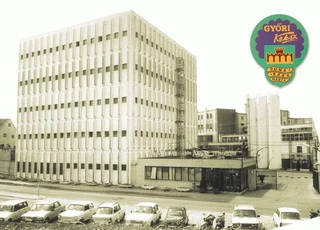
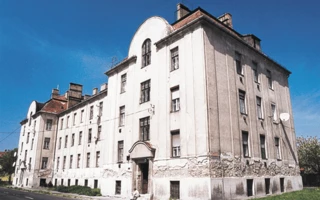
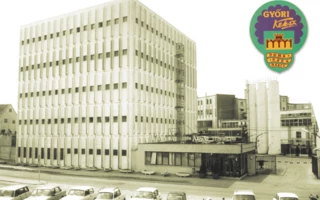
The country's first biscuit factory was located here. In 1880, Back Hermann converted his steam mill in Győr into a confectionery factory under the name Hungarian-English Biscuit Factory Limited. The company operated until 1894, after which, from 1900, Bavarian businessman Lajos Koestlin, who had moved from Bregenz, Austria , founded and operated a biscuit factory on this site. This factory was the predecessor of the internationally renowned Győr Biscuit and Wafer Factory, which operated here until 2009. Győri Keksz Kft. remained in Győr until the summer of 2019. At that time, the factory, which belongs to the Mondelez group, permanently closed its modern plant built in the Győr Industrial Park, which only retained the production of Negro and Halls candies from its previously very wide product range. At this location, only the factory's four-story warehouse building, office building, and former workers' quarters are reminders of the company with its patina. |
| DETAILED COMPANY HISTORY |
Koestlin Lajos and Partners Co. Ltd. began operating in this location in 1900, and 13 years later it employed a thousand people.
The August 25, 1900 issue of the Győri Hírlap reported on the opening of the factory, which began operating immediately after obtaining the industrial license:
"The biscuit factory, which has not been operating for years, has been taken over by the famous Koestlin company and has been in operation for days now. The huge machines arrived in six wagons, with which they make the tastiest of cakes. The factory is preparing hard for the September exhibition, where they will show the public that they deserve their patronage."

Koestlin Lajos

The workers' quarters of the Koestlin factory built in 1911
Did you know that...
The novel-like details of settling in Győr and founding a company
The Back factory in Győr was recommended to Koestlin by the traveling salesman Diamant Emánuel. The factory site, which was already out of operation at the time but had excellent potential, changed hands after negotiations lasting more than two years (1898–99). Since the purchase price received for the Bregenz factory proved insufficient to purchase it, Koestlin was forced to enter into a partnership.
Accepting the offer of his accountant, one of his co-capitalists became the Viennese industrial tycoon, Gusztáv Heller and his wife. The third member of the company, which was transformed from a family business into a public limited company, was Emanuel Diamant, who had found the premises necessary for the relocation. With his “lottery” jackpot, the new company already had enough money to properly equip the starting plant.
The Albert story
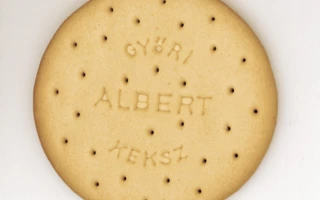
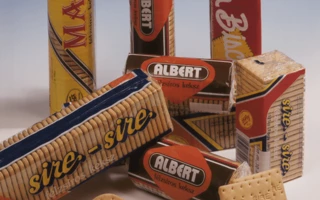
Albert biscuits are undoubtedly the oldest Hungarian confectionery product still in existence today, and have been produced by Győri Keksz Kft. and its legal predecessors since 1912. At that time, Koestlin purchased the most modern biscuit production equipment of its time from England, and with it the recipes and manufacturing rights for several products (Albert, Sire-Sire, etc.).

Did you know that...
Where did the Albert biscuit get its name?
The Albert biscuit was named after Queen Victoria's husband, Prince Albert.
Among the factory history relics, the oldest recipe books date back to the time of the Monarchy and were written in German.
Of interest are the English and Zsigmond Heller versions of Albert pasta from 1912. The raw materials used are fundamentally different from today's, despite the fact that the composition is nearly identical.
In recent decades, several changes can be traced in recipes, which are basically the result of technical and technological developments.
During the four years of World War I , the factory, as the leading factory in Hungary, achieved unprecedented turnover to meet the needs of the military and the general public. During this period, the main products produced were biscuits, waffles, cvibak, military biscuits, and later saccharin.

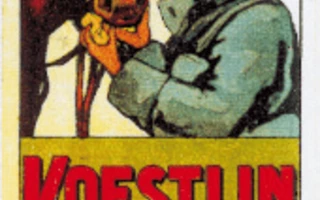
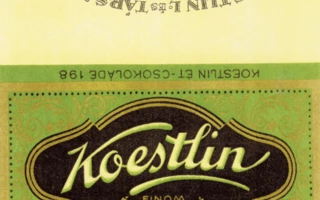
The graphics of Koestlin packaging were largely adapted to wartime conditions.
Following the dissolution of the Austro-Hungarian Monarchy on March 21, 1919, Koestlin – like all factories employing more than 20 workers – became the property of the workers' councils. The nationalization did not cause any significant changes in the factory's production.

Koestlin products were known throughout Europe
Due to the company's serious financial situation, the board of directors of Koestlin Lajos és Társai Rt. leased the company to a syndicate jointly established by the Pesti Magyar Kereskedelmi Bank Rt. and the Leipziger Vilmos Szesz és Cukorgyár Rt. in 1945. The company's name was changed to Koestlin Bérlő Rt.
Koestlin Bérlő Rt. was nationalized in 1947 .
The Győr Biscuit and Wafer Factory was founded.
A significant milestone in the history of the outstandingly performing Koestlin factory is the founding charter issued by the Minister of Light Industry on May 23, 1950, in which the company was registered under the name “Győri Keksz- és Ostyagyár Nemzeti Vállalat” instead of the previous form of a joint-stock company. István Fürst held the position of director of the new company.

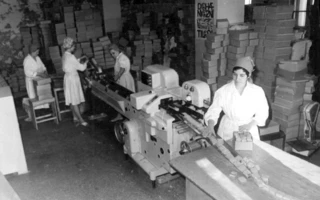
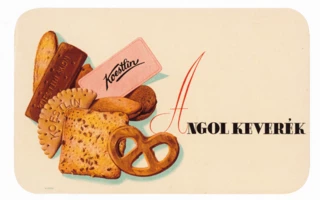
Biscuit packaging in the 1950s
On January 1, 1963, the Economic Committee's resolution merged the six confectionery companies and two factories operating at the time into one large corporation, as well as establishing a trust for dozens of companies operating in the same profile.
The Győr Biscuit and Wafer Factory became the 4th factory of the Hungarian Confectionery Industry.

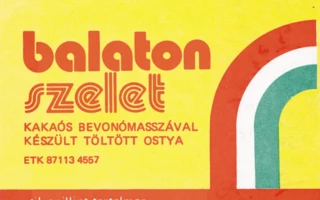
The Balaton slice has been produced by the Győr Biscuit and Waffle Factory since the 1970s.
With the dissolution of the Hungarian Confectionery Company in 1981, a new chapter began in the history of the Győr Biscuit and Waffle Factory, which regained its independence.

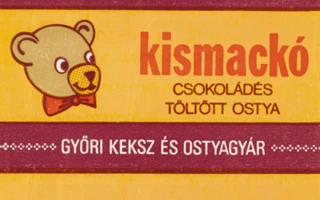
The chocolate Teddy Bear bar was one of the successful products of the 1980s
Special privatization
In the 1980s, Hungary moved towards a liberalized market economy. The Győr Biscuit and Cookie Factory, as the Hungarian company with the best development and economic results in the sector, managed its privatization itself, and the winning company was the English United Biscuits.
The new company was registered by the County Court of Companies on April 12, 1991 under the name Győri Keksz Kft.

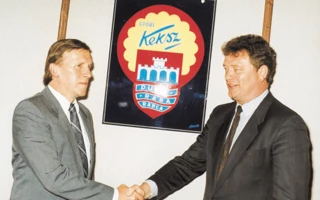
The privatization contract was signed by Director Mátyás Halbritter and Alan Palmer, UB's export director.
Did you know that...
Who got married?
United Biscuits (UB) was one of the UK's leading food companies in the 1990s. It sold its products in more than 80 countries from factories in 19 countries.
The company's success can be seen from the sales revenue of 2.979 million British pounds realized in 1991.
UB's history dates back to 1830, when William McVitie and his son opened a grocery store in Edinburgh. They continued to grow through various corporate mergers, until in 1948 they merged with Macfarlange Lang to form United Biscuits. With the addition of other companies and the acquisition of the American Keebler in 1974, the British company developed into the world's leading biscuit manufacturer. Thanks to its purposeful business policy, it became the market leader in Denmark, the Netherlands, Finland and, with the acquisition of Győri Keksz Kft., Hungary.
He knew that...
How was the Champion slice born?
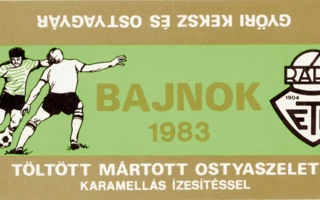
In the spring of 1983, the football-loving population of Győr was in a fever, as the local team had a good chance of winning the championship. This was decided in the last home match. With considerable risk and great optimism, the Győri Biscuit and Waffle Factory launched a new product on the market, timed to the day of the match.
The excellent marketing idea worked, as Rába ETO actually won the decisive match, thus becoming the champion.

Of course, the success of the Champion's slice was not left behind. It was sold in the stadium immediately after the match. It may be unbelievable, but it was certainly the only Hungarian sweet that could be sold at a price well above the store price! For a few days, instead of 2.90 HUF on the black market, enthusiastic fans could only get it for around 10 HUF. The product, sold throughout the country, was an undisputed success everywhere.
A failed factory closure
UB's main goal was to become the market leader in Europe. This was achieved in early 2000 when a financial investor group cooperating with the world's two leading biscuit powers bought its shares and then sold Győri Keksz Kft. to the French company Danone.
Danone envisioned the company's future not in Győr, but in the Székesfehérvár plant, which the British United Biscuits (UB) had purchased from Stollwerck in 1999. The plan to close the Győr plant was ultimately abandoned due to national outrage. Instead, they decided to build a new plant in the Győr Industrial Park (which was opened in November 2009) and then close the Győr-Sziget site (which was demolished in 2010).
2019: Negro is no longer "from Győr"
From 2007, following the change of ownership, Győri Keksz Kft. continued to operate as a factory of Mondelèz Hungaria Kft.
Mondelèz International Inc. was formed by the split of Kraft Foods International Inc., the parent company of Mondelèz International Inc., in October 2012; it operates in more than 100 countries and is the world's largest snack food company with annual sales of $35 billion. It is the market leader in Hungary in the chocolate, biscuit and candy product categories.
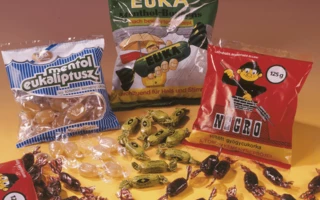
The Győr plant retained only the production of Negro candies from the company's previous wide product range. In addition, the candy production lines will be used to contract manufacture Halls candies until the summer of 2019, when the lines will be dismantled and the factory building will be sold.
This decision marks the definitive end of the history of one of the factories in Győr with a storied past.

Today, sweets are no longer “Győri”…
Koestlin's main products
A few popular brand names from the 334 products produced by the Koestlin factory in the 1930s.
Biscuit, wafer and biscuit products:
Albert, Sire-Sire, Ramona, Cheese Stick, Pretzel, Graham Cracker, Carlsbad Cracker, Baby Sponge Cake.
Candy and jelly products:
Lemon ball, Orange ball, Coffee fouré, Molfetta, Tosca, Bavarian malt, Pemeteű, Eucalyptus, Jelly beans.
Chocolate flavors:
Cream chocolate, Dark chocolate, Milk pastille, Hazelnut milk chocolate, Chocolate cigar, Cat's tongue, Pralines, Chocolate dragees.
From the 120–130 types of bonbons, mixtures of the most diverse flavors were produced:
Mille Fleurs, Boulevard, Luxury mix, Léda, Oktogon, Gavotte.

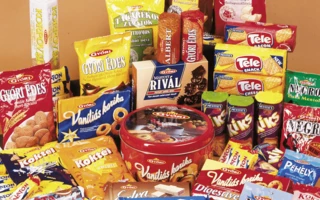
Products of Győri Biscuits
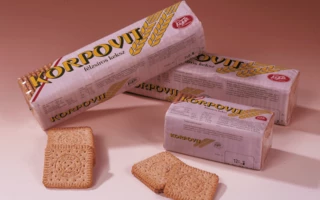
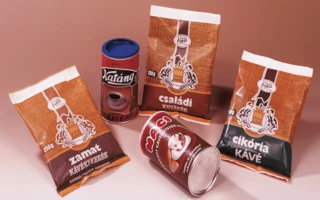
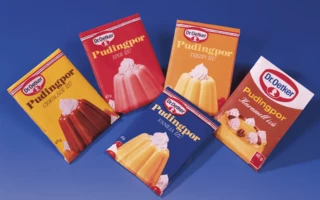
The wide product range of Győri Keksz was well known and loved by both Hungarian and foreign consumers.


| LITERATURE |
Source:
Mátyás Halbritter–Zsolt Andorka: 100 years of biscuit production in Győr (company history book – 2000)
Related gallery

Back to the previous page!